XAUUSD · METATRADER 5 · TESTED ON UNSEEN DATA
A gold trading bot that benches its own losing strategies
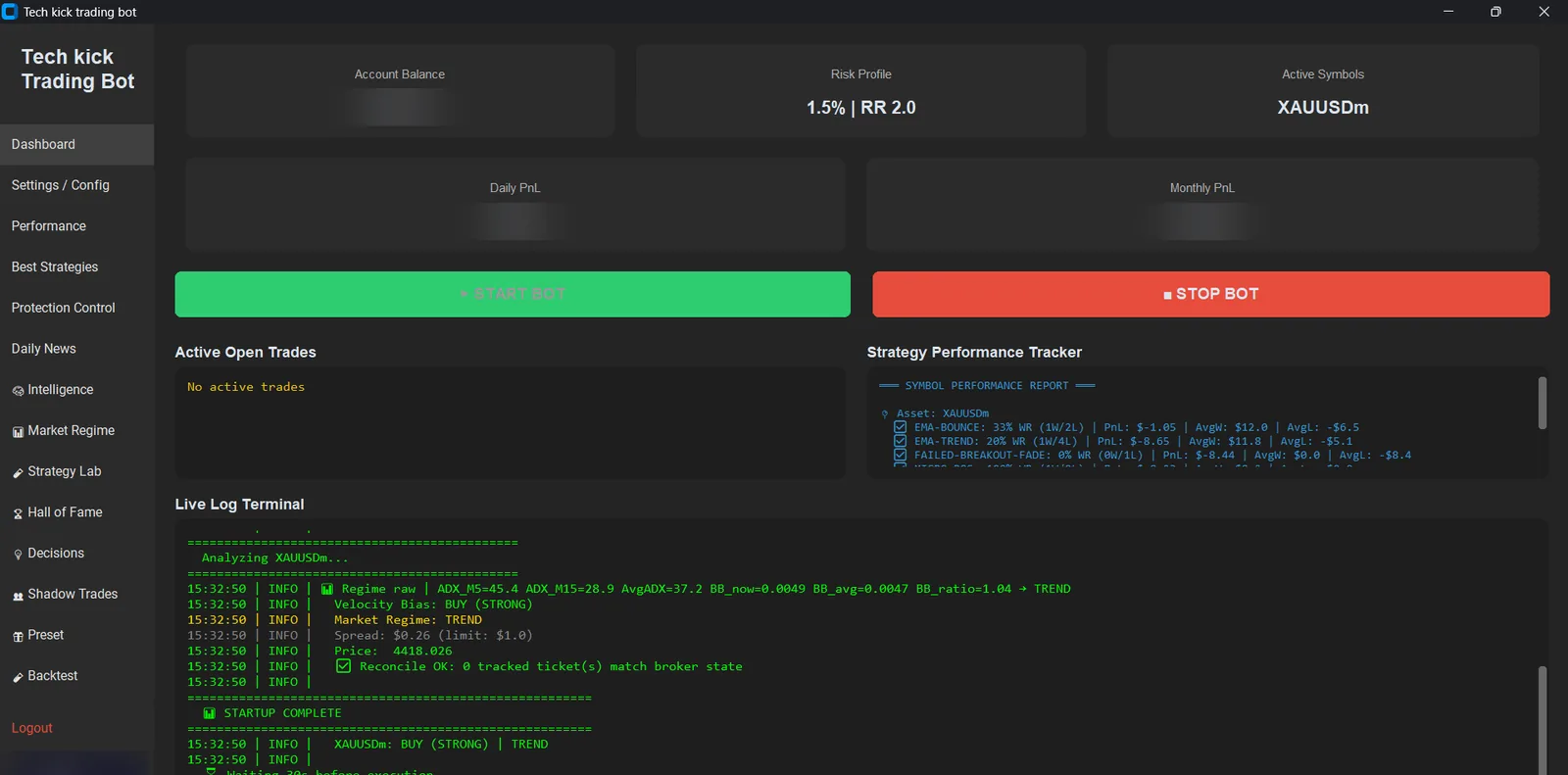
Most XAUUSD bots run one strategy and hope the market keeps cooperating. Tech Kick Bot was built by testing 34 of them — six built only for gold — scoring each on the lower bound of its measured win rate, and shipping only the four that earned it. Just the current leader touches your account, and when a strategy stops working it gets suspended automatically instead of quietly draining the balance.
30-day guarantee if it does not work · Hardware-locked licence · Cancel anytime
What it is, precisely
| Instrument | XAUUSD (Gold) | Single-symbol by design |
|---|---|---|
| Platform | MetaTrader 5 | |
| Strategies tested | 34 | Only the proven ones ship enabled |
| Timeframes scanned | M1 · M5 · M15 | |
| Trading hours | 06:00 – 21:00 UTC | |
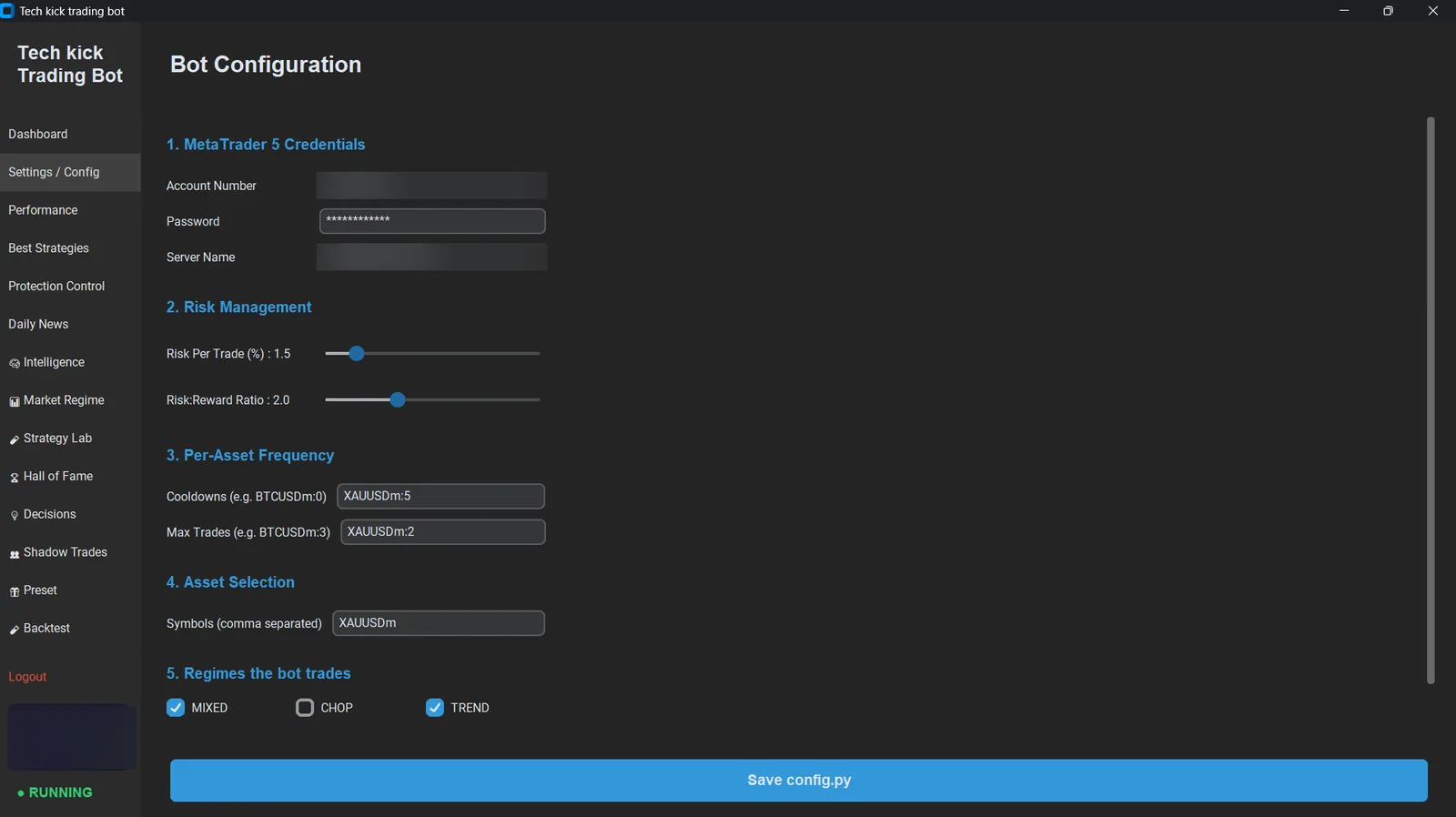
| Market regimes | Trend · Mixed | Chop ships disabled — it lost money |
| Default risk per trade | 1.5% of balance | User-configurable |
| Default reward:risk | 1 : 2 | |
| News shield | High-impact calendar | On by default |
| Spread guard | Blocks entries above threshold | |
| Daily lockdown | Hard profit + loss stop | |
| Minimum balance | $100 | $700+ for % risk sizing to work; $1,000 ideal |
| Operating system | Windows 10 / 11 / VPS |
How the bot decides what to trade
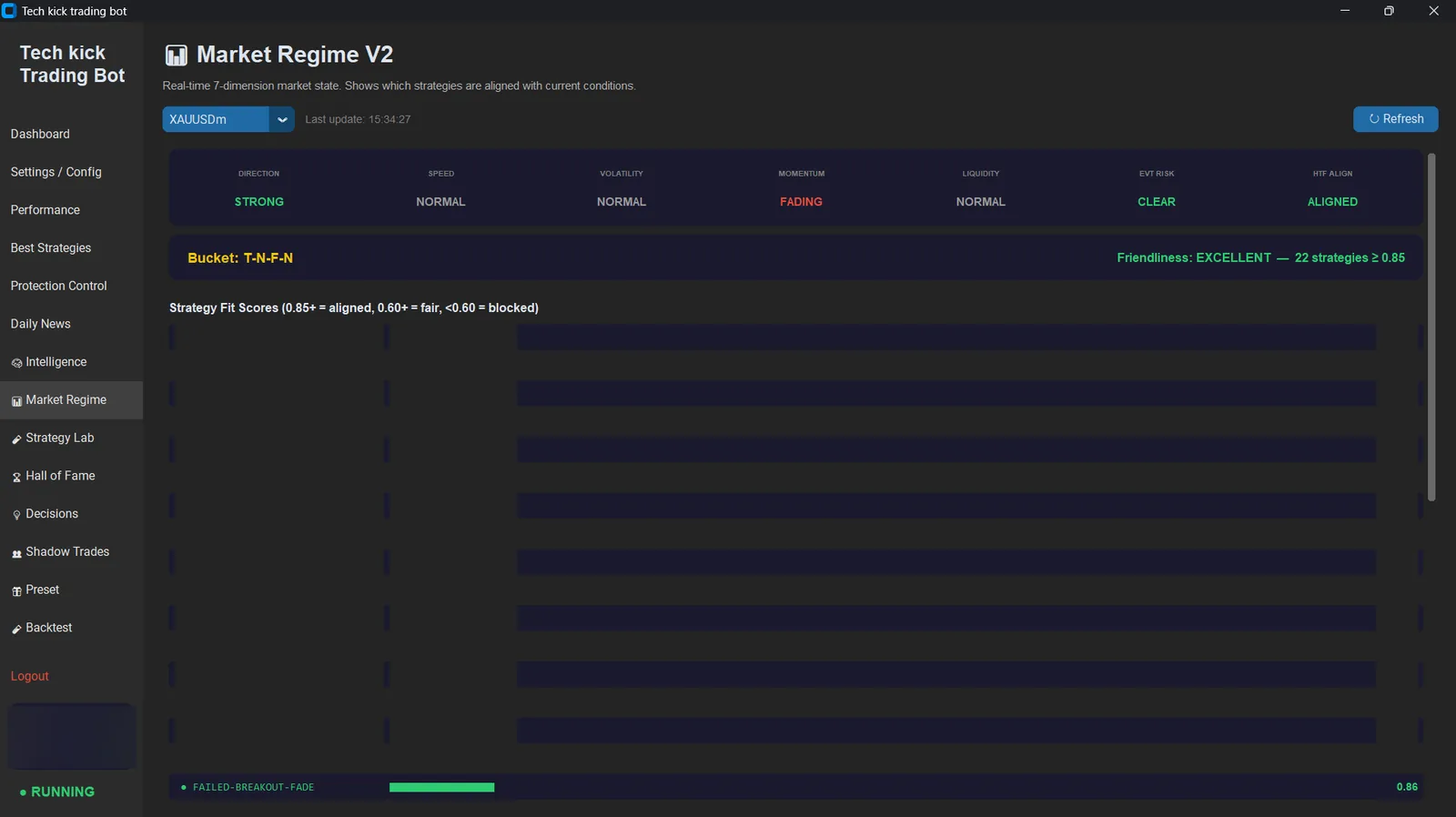
1. It reads the regime first
Before any signal is considered, the engine classifies the current market as trending, chopping, or mixed. This matters more on gold than on most instruments: a breakout strategy that prints money in a trend is exactly the strategy that bleeds in a range. Strategies are gated by regime, so mean-reversion logic simply is not eligible during a strong trend.
2. Every eligible strategy submits a signal
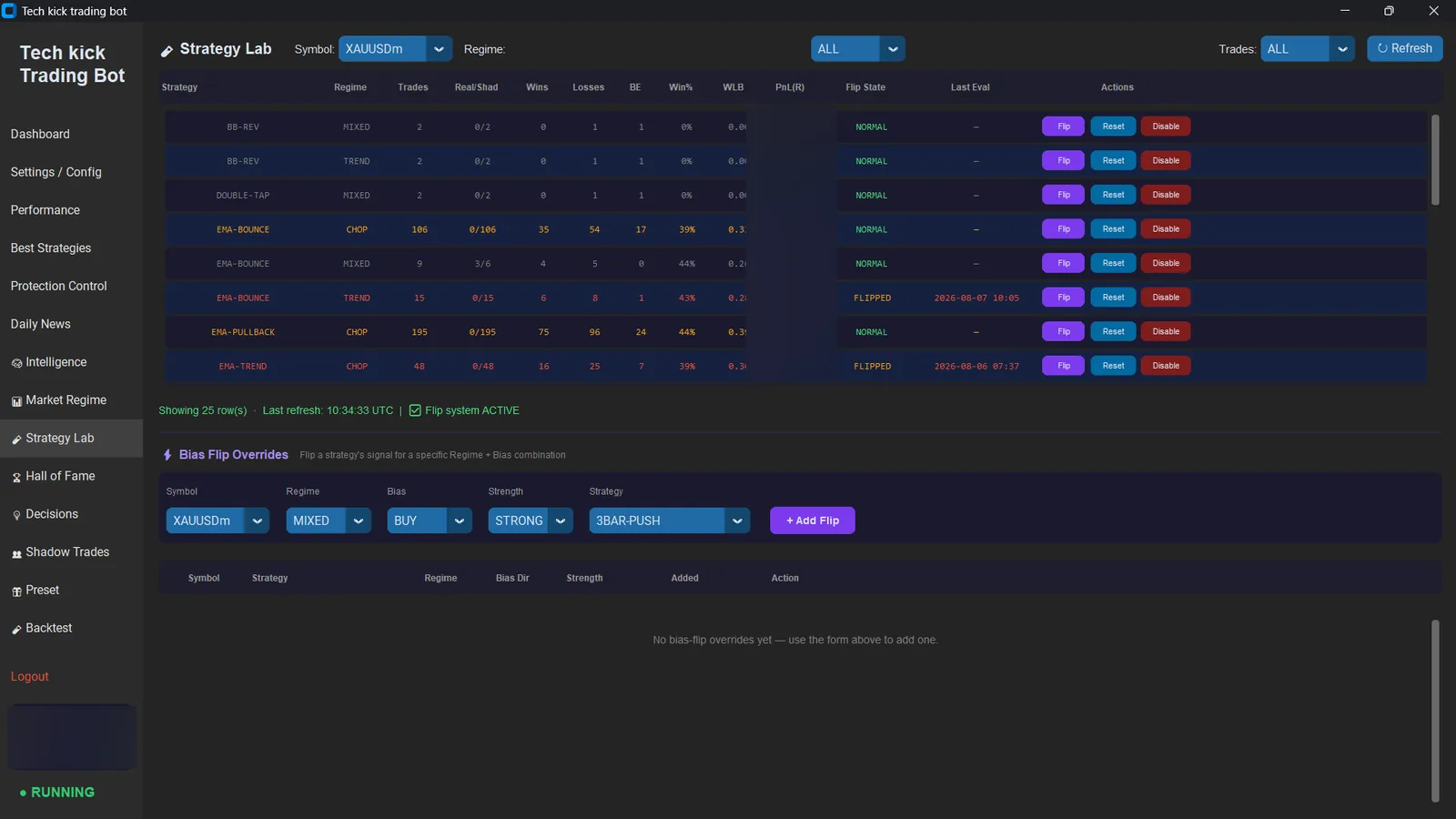
Across M1, M5 and M15, each enabled strategy independently reports whether it sees a setup. Smart-money logic (order blocks, liquidity sweeps, structure shifts) runs alongside classical logic (VWAP mean reversion, EMA pullbacks, Bollinger reversals), with anything that could not prove an edge switched off.
3. Signals are scored on confidence, not luck
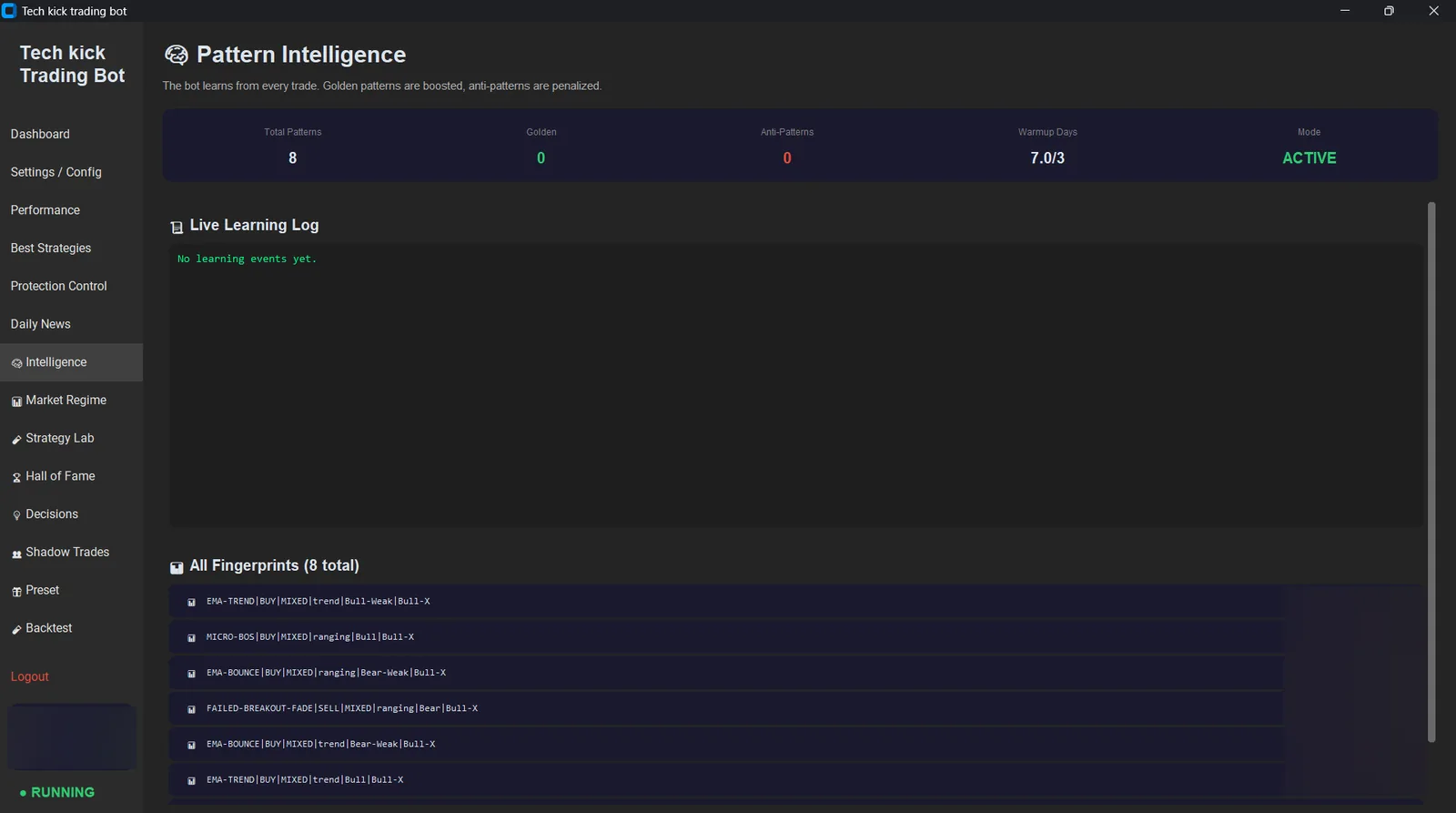
Each signal is ranked using the lower bound of its strategy's win-rate confidence interval. A strategy that is 3-for-3 scores below one that is 60-for-100, because three samples prove nothing. This is the single most important design decision in the engine — it is what stops the bot chasing whichever strategy got lucky this morning.
4. Only the champion executes
Duplicate signal types are collapsed, the highest scorer wins, and position size is calculated as a percentage of your balance with stop loss and take profit attached immediately after fill. Everything else is discarded — the bot does not stack correlated entries just because several strategies agreed.
The parts that stop you blowing the account
Entry logic is the part everyone markets. These are the parts that actually decide whether an account survives twelve months.
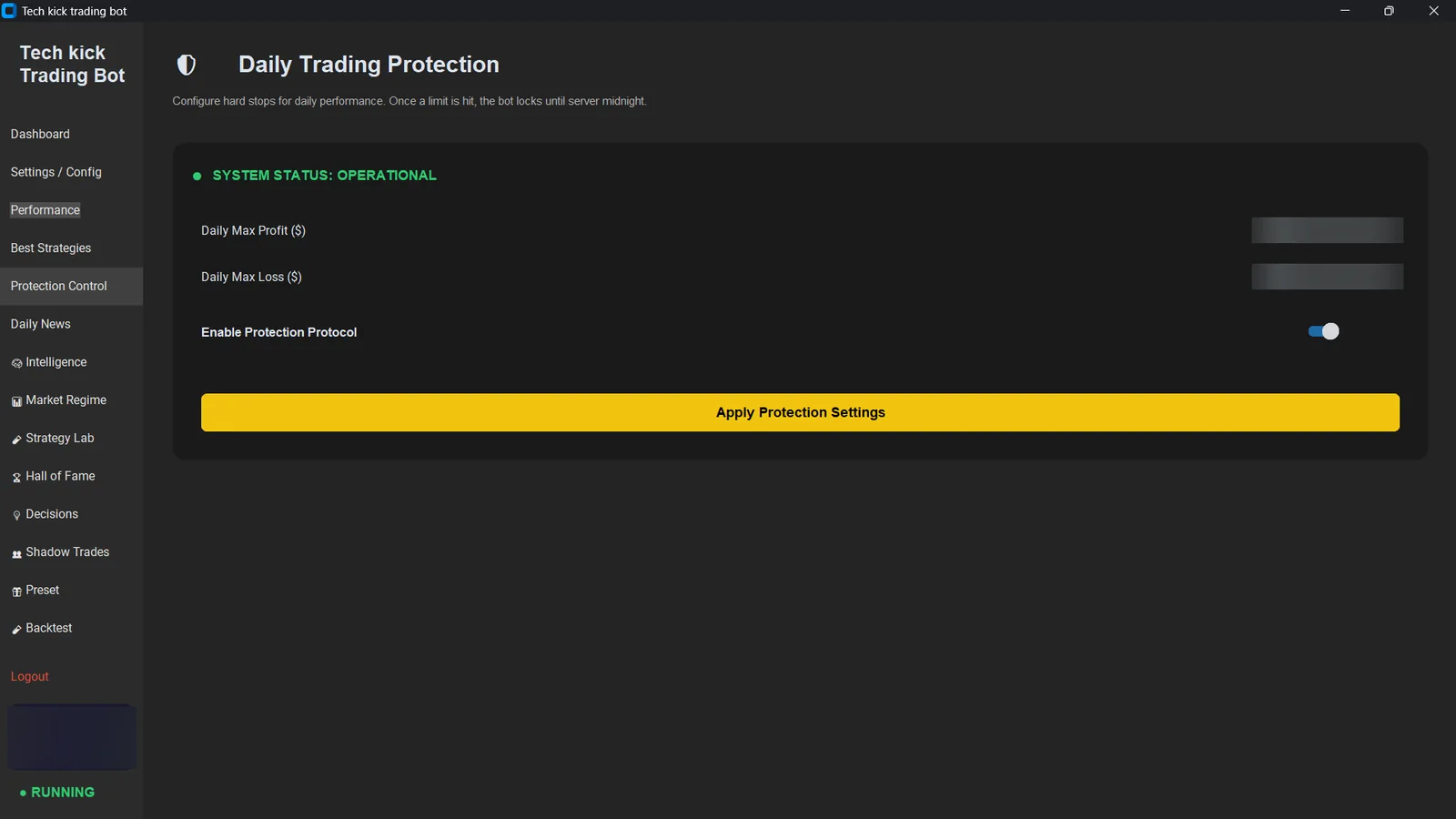
Daily lockdown
Hard profit and loss thresholds. Once either is hit the bot stops for the rest of the server day — the mechanism that makes revenge-trading structurally impossible.
News shield
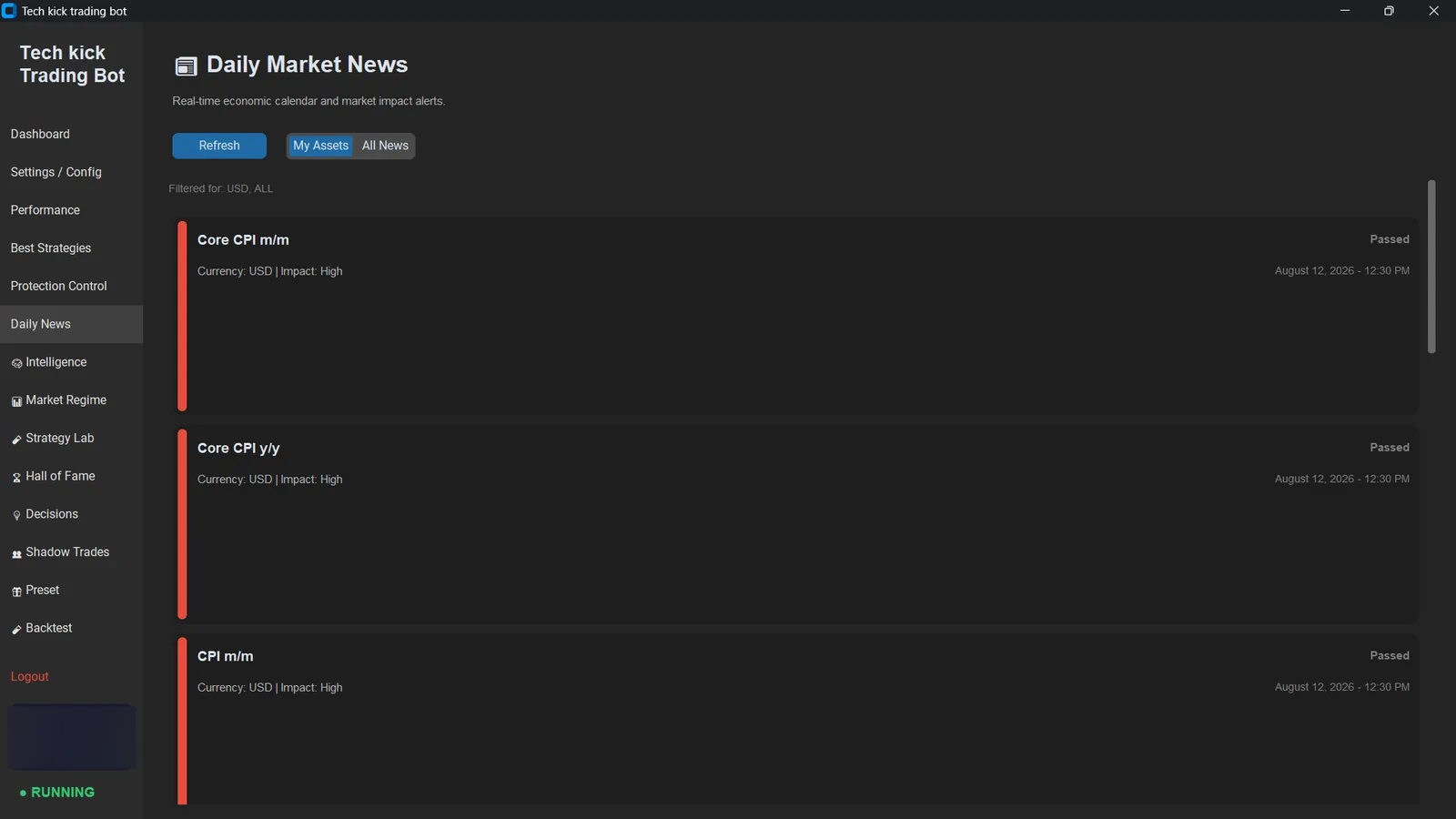
Pulls the high-impact economic calendar and refuses entries around CPI, NFP and FOMC, when gold gaps and spreads blow out.
Spread guard
Rejects any entry while the spread sits above a configured ceiling, so the trade does not start in a hole it cannot climb out of.
Loss-streak pause
After consecutive losses the engine pauses globally rather than continuing to fire into conditions it is clearly misreading.
Auto-suspension
A strategy that falls under the win-rate floor after a minimum sample is benched, then re-evaluated later. Underperformers are removed from rotation automatically.
Two-tier trailing stop
Stop moves to breakeven partway to target, then locks in a portion of open profit as the trade matures.
Who can actually run this
If you are trading from the United States
US residents cannot trade spot gold CFDs through a standard retail account, and the broker this bot is tuned for does not accept US clients. We would rather tell you that here than take a subscription you cannot use. The route that does work is a proprietary trading firm account — you trade the firm's simulated capital under their rulebook, on MetaTrader 5, with gold available. Check two things before you start: that the firm permits Expert Advisors, and that you have set the daily loss lock below their drawdown limit. We cover the setup in detail on the prop firm trading bot page.
Everywhere else
Any MetaTrader 5 broker offering XAUUSD works. The bot is pre-configured for Exness ECN and Raw Spread accounts, including their symbol naming, so that path needs no setup changes. Raw-spread or ECN account types are strongly recommended — the strategy mix is spread-sensitive and a wide standard-account spread will erode it.
If Exness is your broker, the Exness setup page covers the ECN order handling, the XAUUSDm symbol and which account type to pick. If you are still choosing a broker, the platform comparison sets out the four ways to trade gold and what each one costs.
Gold trading bot FAQ
What is a gold trading bot?
A gold trading bot — also called an auto trading bot or Expert Advisor — is software that opens, manages and closes XAUUSD trades automatically on your MetaTrader account using pre-coded rules, with no manual input once it is running. Tech Kick Bot is a gold trading bot for MetaTrader 5 built by testing 34 separate strategies, disabling the ones that could not prove an edge, and routing live execution only to whichever survivor currently has the strongest measured win-rate confidence.
Why does the bot only trade gold instead of multiple pairs?
Because narrow beats broad. Gold has a distinct volatility profile — it routinely moves several times the daily range of a major FX pair — and strategies tuned for that behaviour perform poorly elsewhere. We previously ran Bitcoin alongside gold and disabled it after it produced a net loss across 117 trades at a 28% win rate. Rather than hide that, we removed the symbol. The same principle governs the strategy list: of 34 strategies built and tested, only the ones that proved an edge on gold are enabled for live trading.
How does the strategy tournament actually choose a trade?
On every scan the engine collects valid signals from all eligible strategies. Each is scored using the lower bound of its measured win-rate confidence interval, not its raw win rate — so a strategy that went 3-for-3 does not outrank one that went 60-for-100. Base priority and timeframe weighting are added, signals are deduplicated by type, and only the highest scoring signal is executed. A strategy that drifts below the win-rate floor after a minimum sample is automatically suspended.
Can traders in the United States use this bot?
Not through a standard retail broker account. US residents cannot trade spot gold CFDs at retail, and the broker the bot is tuned for does not accept US clients. The route that does work for US-based traders is a proprietary trading firm account — you trade the firm's simulated capital under their rules, which is not restricted the same way. Confirm your firm permits Expert Advisors before running any bot, and check the daily loss lock is set inside their drawdown limit.
Does it work on prop firm challenge accounts?
It is compatible with MetaTrader 5 prop firm accounts, and the daily profit and loss lockdown maps directly onto the daily drawdown rule most firms enforce — once your configured loss threshold is hit, the bot stops trading for the rest of the server day rather than continuing into a breach. You must still set the threshold below your firm's limit yourself, and confirm the firm allows EAs. No bot can guarantee passing a challenge.
What happens during high-impact news?
The news shield pulls the high-impact economic calendar and refuses to open positions inside a window around each event. Gold reacts violently to CPI, NFP and FOMC releases, and spreads widen sharply — entries taken into those conditions are where automated systems most often take outsized losses. The shield is enabled by default.
Do I need to leave my computer on?
The bot needs MetaTrader 5 running to trade, so either your PC stays on or you run it on a Windows VPS. A VPS is the normal setup — it keeps the bot online through reboots and power cuts and sits closer to the broker's servers, which reduces execution latency.
How much money do I need to run it?
It runs from $100, and we would rather explain what changes at that size than pretend nothing does. The broker's smallest trade is 0.01 lots, which costs roughly $9 to $12.50 of risk on gold. On a $100 account that works out to about 10% risk per trade rather than the 1.5% you configured, because the trade cannot be made any smaller — position sizing simply cannot respond to risk at that balance. The bot itself will tell you this at startup if you run it under $700. Simulated from $100 across 2026, the shipped configuration still drew down 36%. From around $700 percentage sizing starts working as designed, and $1,000 is the balance the backtested figures on this site were measured at. Starting small is fine as long as you know you are trading a much more aggressive risk profile than the settings suggest.
What did it do in backtesting?
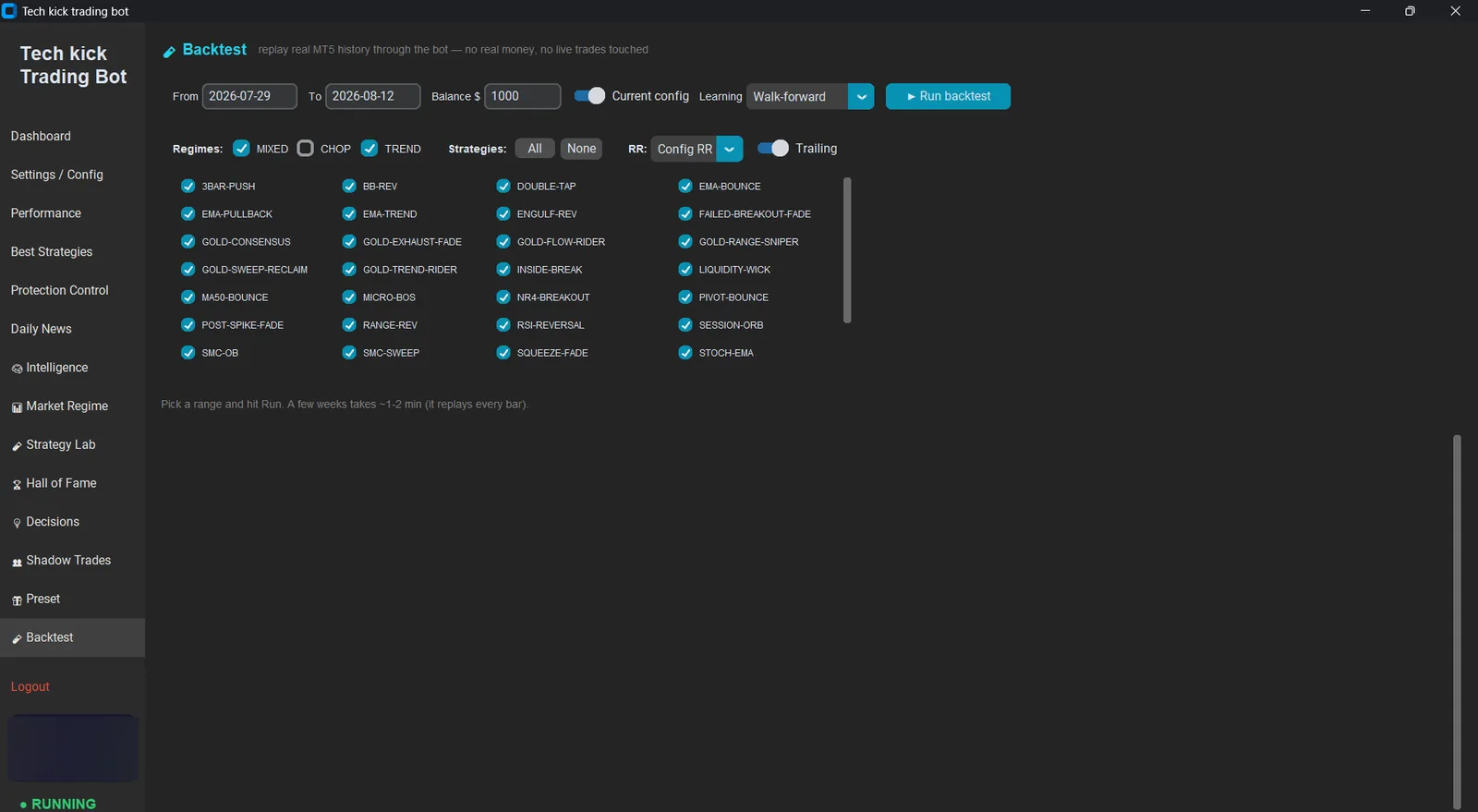
There are two measurements and they answer different questions. Run as one unbroken seven-month stretch on a $1,000 account with the Conservative profile at a flat 0.05 lot — the closest thing to an installed bot — it returned +27.8% in total across 42 trades, with a 27.4% maximum drawdown and a 36% win rate. That is the figure to plan around, drawdown included. Replayed on August to December 2025, data the configuration had never seen, it returned +90.3% at a 13.2% drawdown and a 37% win rate — three times the return, which is why we quote the weaker period rather than that one. Separately, the same 2026 months measured as seven independent monthly tests, each restarting the balance and the learning, report +$681.30 against the continuous +$278.45. That method shows the rules have an edge across separate periods; it is not what a continuously running bot reproduces, and its totals should not be projected forward. None of these scale down to a smaller account, because the minimum lot size forces a much higher risk per trade there. Backtested, hypothetical results — not a live track record.
What does it cost and is there a refund?
The bot is $20 per month with a 30-day guarantee against the software not working, and the licence is hardware-locked to one machine or VPS. Contact support to move a licence to a new device.
Run it on demo first
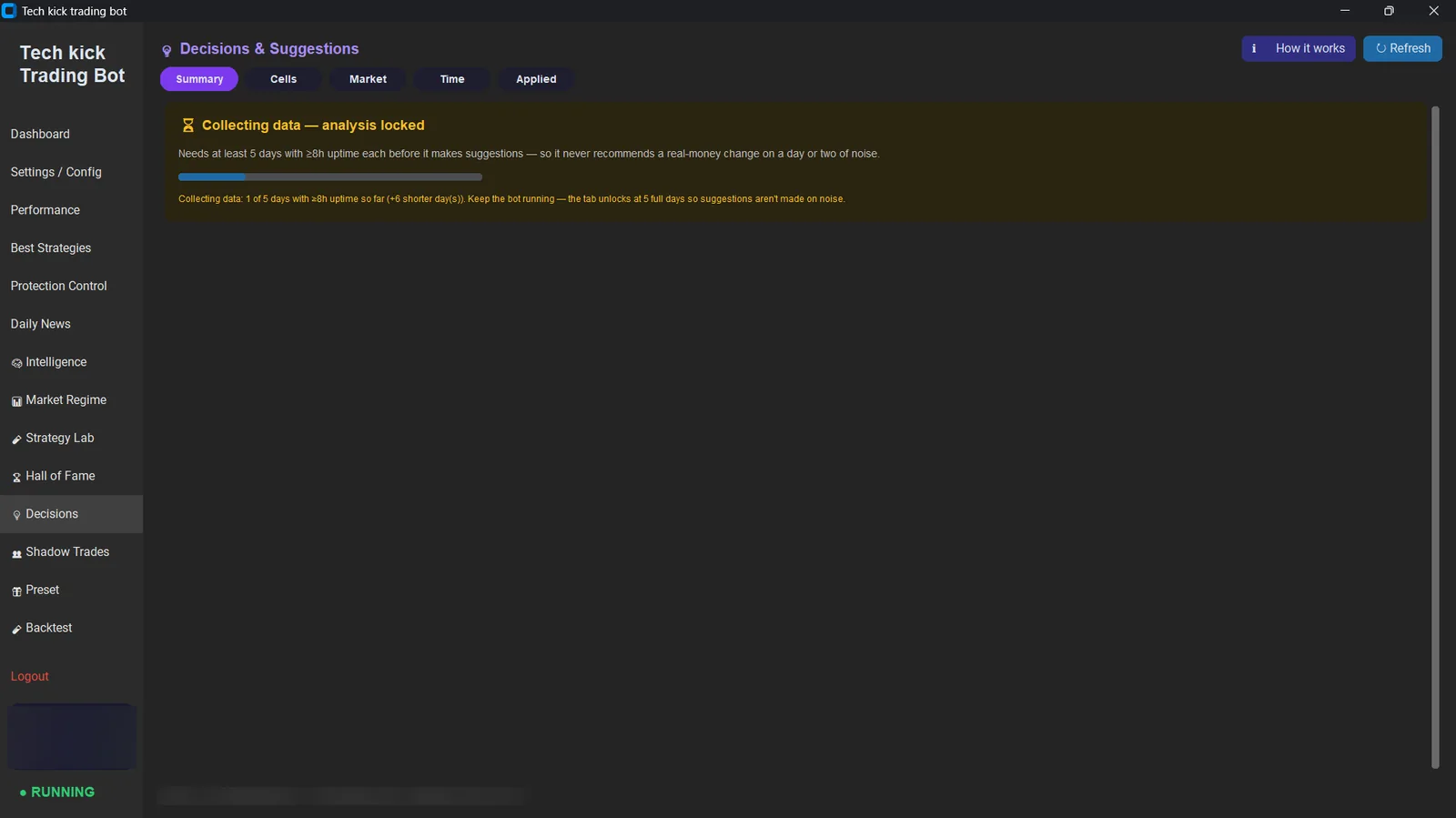
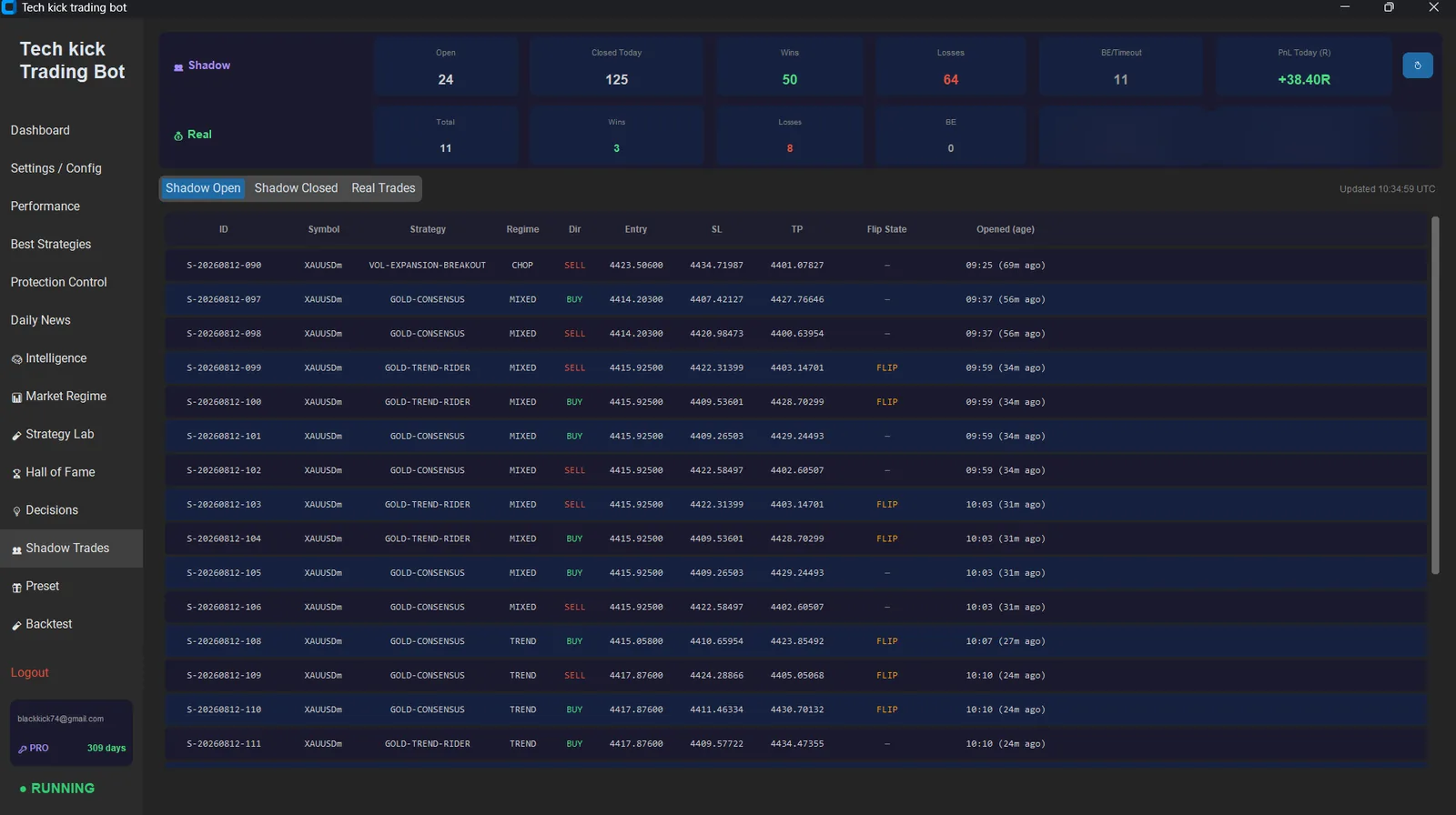
Put it on a demo account, let it trade a full week including a news day, and read the decision log — every entry it took and every one it refused. If it does not convince you, the 30-day guarantee is there for exactly that reason.