EXPERT ADVISOR · METATRADER 5 · GOLD ONLY
An XAUUSD expert advisor that only knows gold
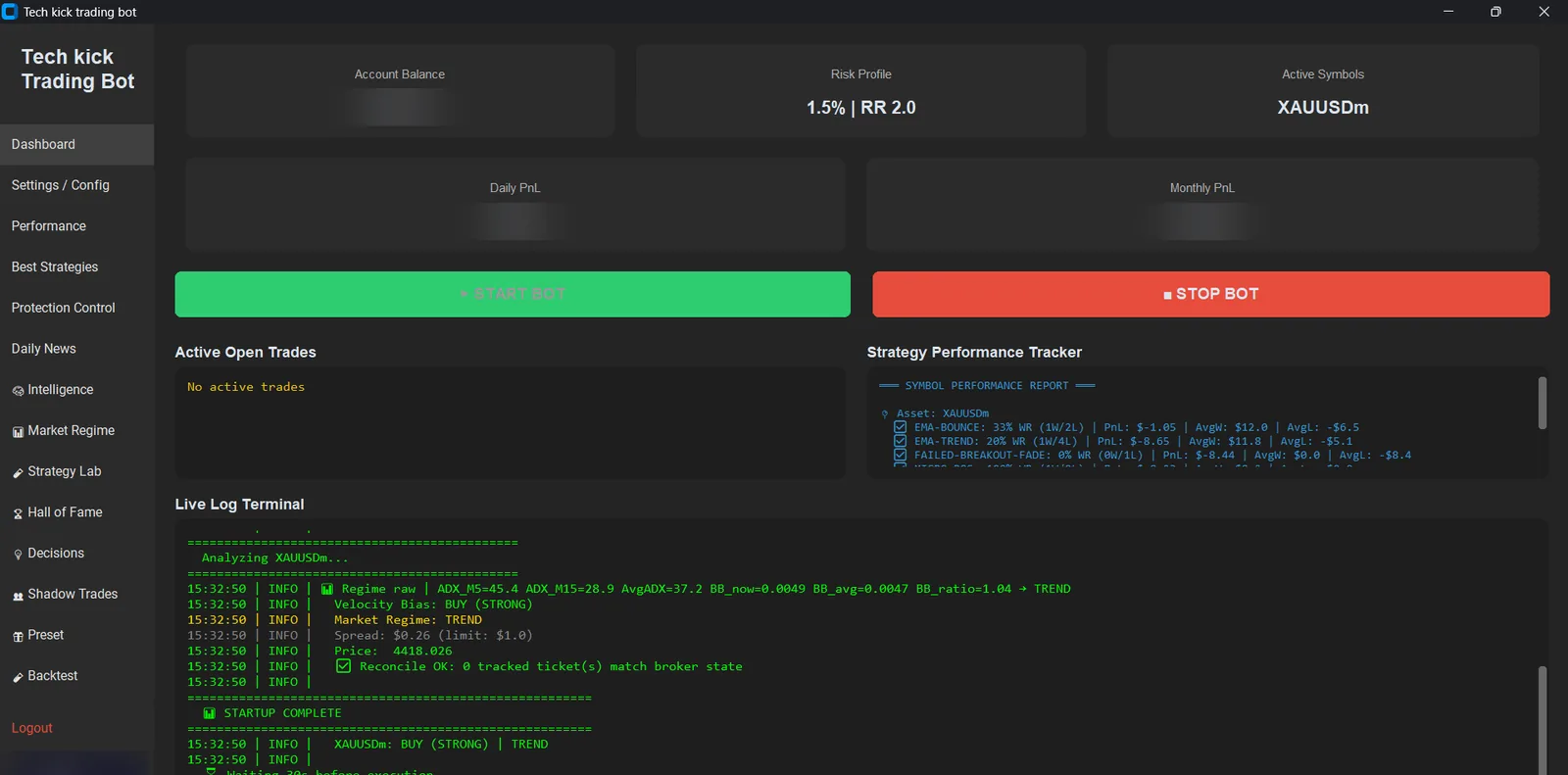
Most gold EAs are an FX system pointed at a metal. This one was built, tested and cut down on XAUUSD data alone — 34 strategies tried, 4 shipped, and an entire second instrument deleted when it could not prove an edge.
What separates a gold EA from a generic one
Stops sized to gold’s noise floor
Gold can move several dollars without meaning anything. A stop calibrated for an FX pair sits inside that noise and gets taken out by movement that was never a reversal.
A spread ceiling that means something
Our threshold is one dollar on XAUUSD. Applied to a different instrument the same number either blocks everything or nothing — which is how spread filters end up doing nothing at all.
Session structure it can use
Gold has real sessions, and sessions create opening ranges, session highs and lows and predictable liquidity. Several strategies key off exactly that, and they have nothing to hold onto on a 24/7 instrument.
News handling built for the reaction
Gold reacts violently to CPI, NFP and FOMC. The news shield pulls the high-impact calendar and refuses entries around those events rather than trading into the worst spreads of the month.
XAUUSD EA questions
What is an XAUUSD EA?
An XAUUSD EA is an Expert Advisor — an automated program running inside MetaTrader — built specifically to trade gold against the US dollar. It watches price, applies coded entry rules, and places and manages trades without you at the screen. The XAUUSD part matters more than it sounds: gold moves in a different way to an FX pair, and an EA tuned for EURUSD behaviour usually performs badly on it.
Why does gold need a dedicated expert advisor?
Because every parameter in an EA encodes an assumption about the instrument. Stop distances assume a certain noise floor, spread filters assume a typical spread, and session logic assumes when the market is liquid. Gold routinely moves several times the daily range of a major FX pair, so a stop that sits safely outside routine movement on EURUSD sits right inside it on XAUUSD. We learned this the expensive way running the same engine on Bitcoin — 117 trades at a 28% win rate before we removed the symbol.
What timeframes does it trade?
It scans M1, M5 and M15, with market structure read from a higher timeframe for directional bias. Lower timeframes give gold enough movement to work with intraday while the higher-timeframe read stops the bot fighting the dominant direction.
Does it work with any MT5 broker?
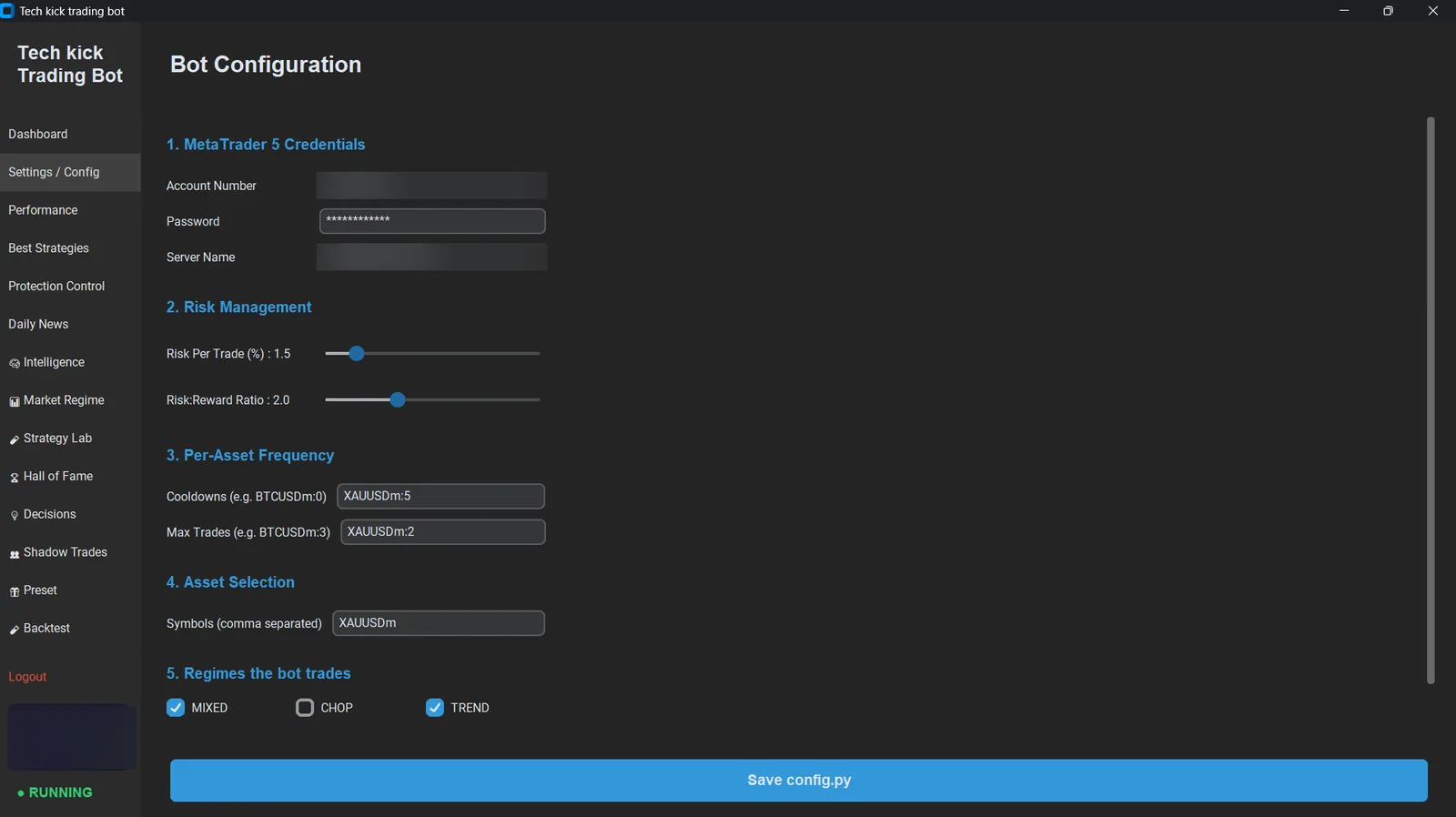
Any MetaTrader 5 broker offering XAUUSD. It is pre-configured for Exness ECN and Raw Spread accounts including their symbol naming, so those need no changes. Elsewhere, confirm the gold symbol name matches and check the typical spread — the strategy mix is spread-sensitive and a wide standard-account spread will erode results regardless of entry quality.
How many trades does it take?
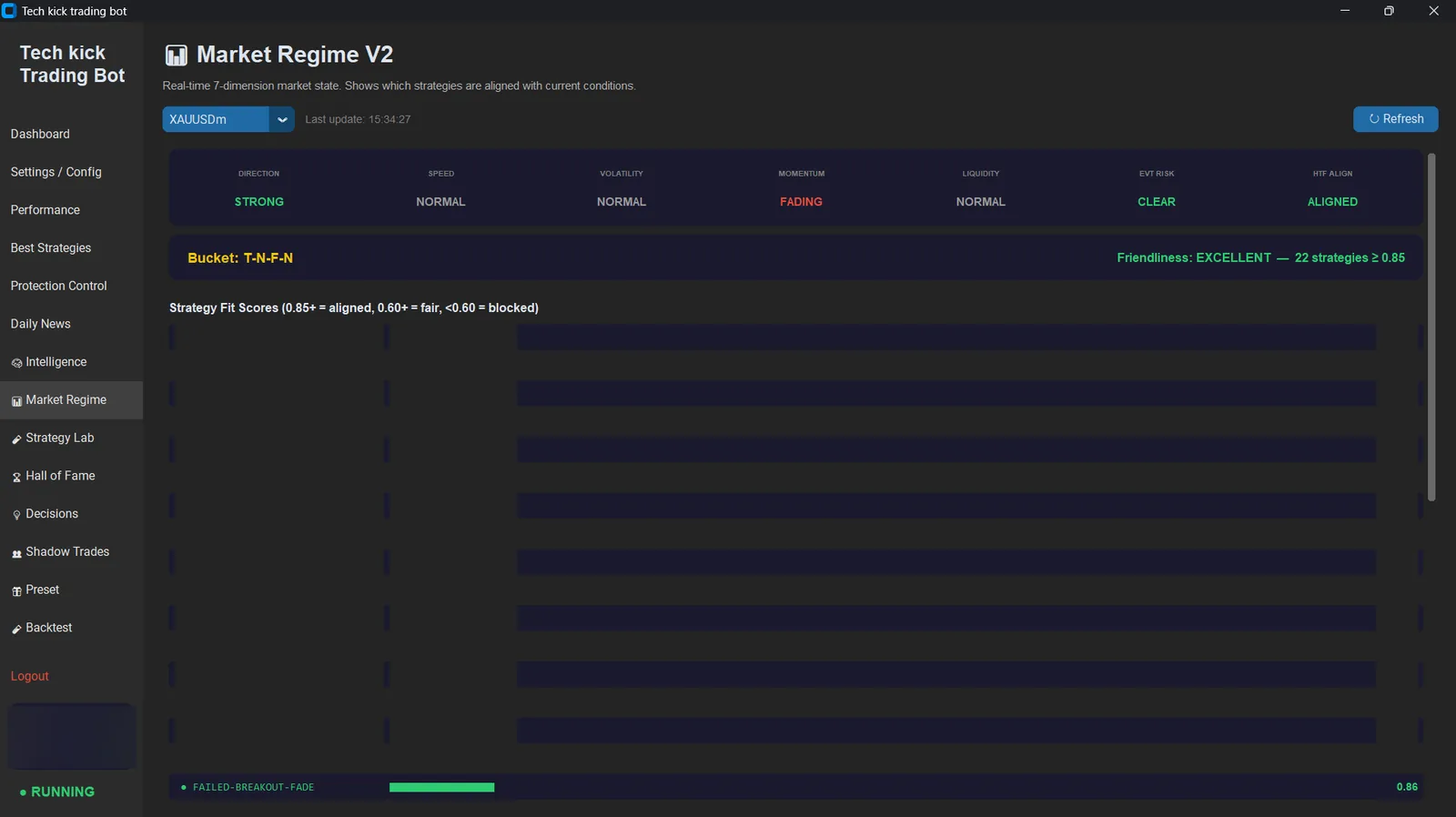
Far fewer than most gold EAs. The gate chain — regime, session, spread, news, cooldown and concurrency — rejects far more setups than it accepts, and there are days where it does not trade at all. Across the backtested periods it averaged roughly ten trades a month. If you want an EA that is constantly in the market, this is the wrong one.
Is it a martingale or grid EA?
No. Every position is a fixed percentage of balance with a stop and target attached after fill. It never averages down, never adds to a losing position, and never opens recovery trades. Those are also the strategy types prop firms most commonly ban, which is why this one is usable on a funded account and many gold EAs are not.
What results has it produced in testing?
Measured as one unbroken seven-month run on a $1,000 account with the Conservative profile at a flat 0.05 lot, it returned +27.8% in total across 42 trades, with a 27.4% maximum drawdown and a 36% win rate. That is the realistic expectation, and the drawdown is part of it. Replayed on August to December 2025 — data the configuration had never seen — it returned +90.3% at a 13.2% drawdown and a 37% win rate. Do not plan on the larger figure: two runs of one configuration differing by three times means the return is not stable, so the weaker period is the one to expect. Backtested, hypothetical results and not a live track record.